News
MoneroKon 2026 Recap: Key Talks and What It Means for Privacy
08 Jun 2026
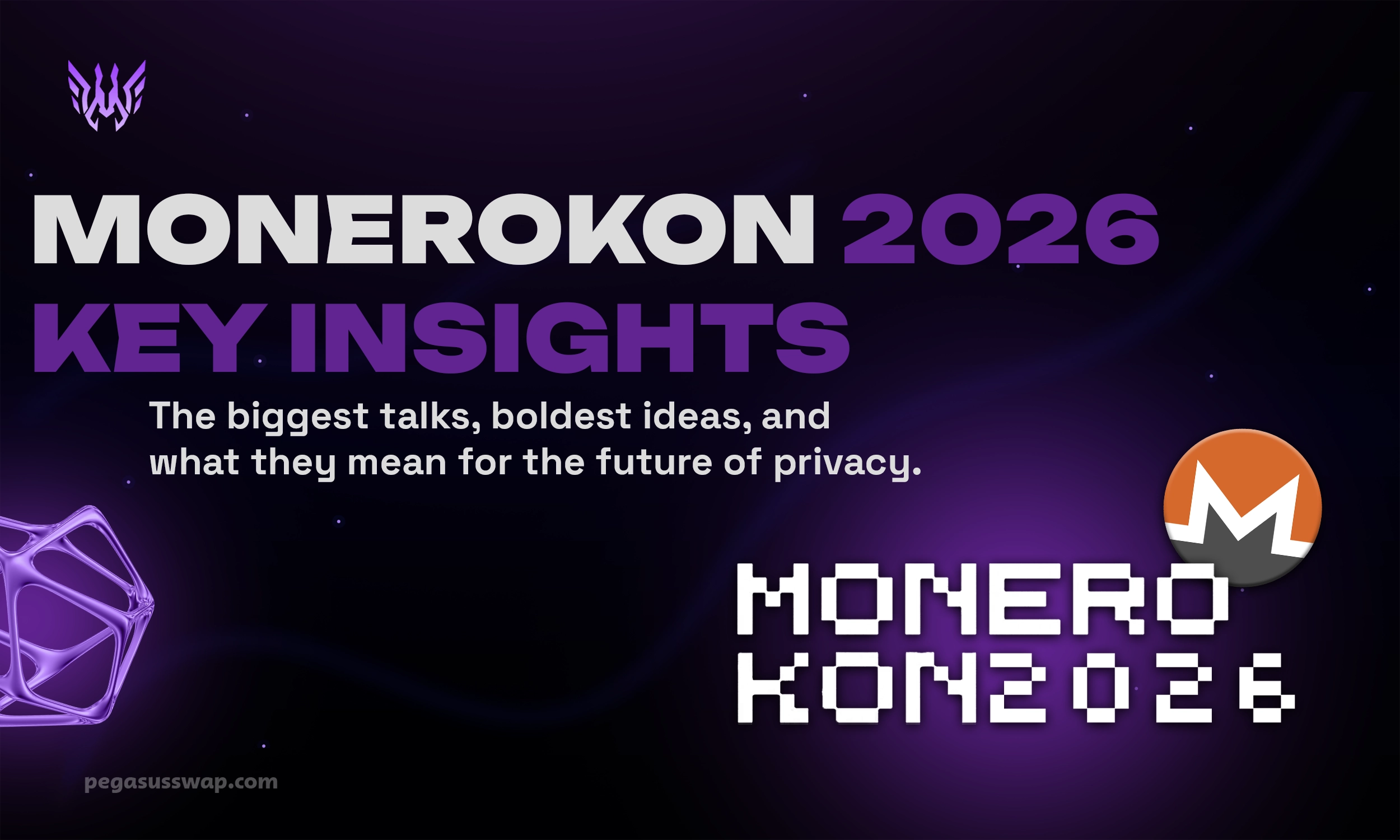
MoneroKon 2026 is done. Three days in Warsaw, inside the Kinoteka cinema at the Palace of Culture and Science, and the sixth edition of Monero’s flagship conference delivered what it always does: serious technical talks, real conversations between people who are actually building things, and a room full of attendees who don’t need to be convinced that financial privacy matters.
PegasusSwap was there as a contributing sponsor. Here’s what stood out.
The Conference in Brief
MoneroKon 2026 ran across two main halls with a packed schedule across all three days. The tone was, as always, developer-heavy and technically serious. This isn’t a conference built around price speculation or investor panels. The talks that drew the most attention were the ones that got into the weeds of how Monero’s privacy architecture actually works and where it’s going next.
The event was co-located with the Bitcoin Film Fest, which added a broader cultural layer to the final day, but the core MoneroKon programme ran independently across Hall 1 and Hall 2 with parallel tracks on days two and three.
Talks That Stood Out
Francisco 'ArticMine' Cabanas opened day two with a talk on Monero scaling — a topic he has covered across multiple MoneroKon editions and one that sits at the centre of the FCMP++ upgrade. The fee market and block weight implications of FCMP++ have been a recurring focus of his research, and the Warsaw session continued that thread in the context of where the protocol stands now.
CypherGoat's presentation on routing architecture and privacy-preserving swap paths drew significant interest, including from our own team. It’s the kind of talk that generates hallway conversations well after the session ends, and it did. We’re planning a dedicated article on this topic once we’ve had time to go deeper on the specifics.
Martin Arness covered Monero offramps, which is directly relevant to the delisting pressure XMR has faced from centralised exchanges over the past year. As custodial routes close, the question of how users actually get in and out of Monero becomes more important, not less. Non-custodial instant swaps are a significant part of that answer.
On day three, the BasicSwap Mobile talk from Dr. Kap and the Monerujo design session rounded out a schedule that covered everything from node architecture to wallet UX, a good signal that the ecosystem is working on both the infrastructure and the user-facing layers simultaneously.
What Happened on the Floor
The conference floor was as useful as the talk schedule. We spent time with our existing partners kycnot.me and Trocador, both of whom were present, and the kind of in-person conversation that’s difficult to replicate remotely.
One broader observation worth noting: SimplexBot came up repeatedly in conversations across different groups at the conference. A number of platforms are beginning to implement it, and there was clear user appetite for seeing it more widely available. It’s the kind of signal that’s useful to track.
More generally, MoneroKon is one of the better environments for meeting people who are serious about building in this space. The networking that happens between sessions and at the evening events is not incidental to the conference, it’s part of the point. We came away with new contacts and a clearer picture of where the ecosystem is heading.
What MoneroKon 2026 Signals
A few things were clear from being in the room for three days.
First, the technical work on Monero is not slowing down. FCMP++, the Cuprate Rust-based node rewrite, wallet improvements across Cake Wallet and Monerujo, and ongoing research into network-level privacy all point to an ecosystem that is actively upgrading rather than coasting. The delisting narrative that dominates mainstream crypto coverage of XMR misses this entirely.
Second, the community that shows up to MoneroKon is not the community that needs convincing. These are the builders, researchers, and long-term holders who understand what Monero is for. The conference exists to move the technical and philosophical conversation forward among people who are already committed to the project, and it does that well.
Third, the regulatory pressure that has pushed XMR off centralised exchanges is, if anything, making the non-custodial infrastructure around Monero more important. Talks on offramps, atomic swaps, and mobile wallet UX are not abstract, they’re responses to a real shift in how people will need to access XMR going forward.
That’s exactly the context in which PegasusSwap operates, and exactly why being at MoneroKon felt like the right place to be this week.
Swap XMR on PegasusSwap
If MoneroKon reminded you why Monero matters, you can act on that right now. PegasusSwap lets you swap any major crypto for XMR instantly, with no account, no KYC, and no registration of any kind.
Swap crypto for XMR on PegasusSwap - no account, no ID, no registration required.