News
The EU Is Losing Binance and USDT on the Same Day. Here's What to Do Now
29 Jun 2026
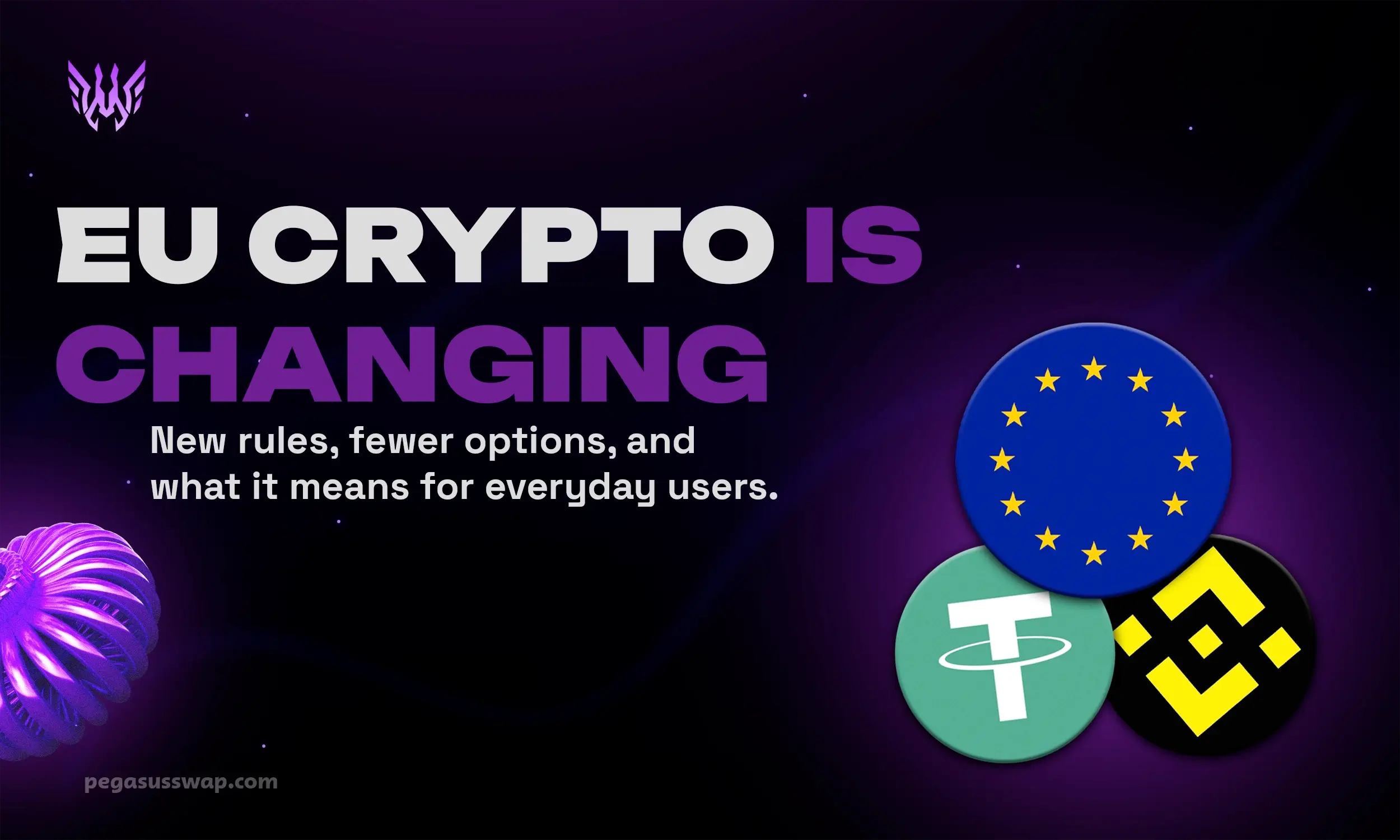
On July 1, two things are happening to EU crypto users at once: Binance suspends services across the European Union, and USDT disappears from every regulated European exchange. Neither event came out of nowhere, but the combination lands hard. If you keep your crypto on a centralised platform and want to keep trading without handing over your identity, your options are about to get much narrower.
Here is what is happening, why, and what you can do before the deadline hits.
Binance Is Suspended in the EU from July 1
Binance, the world’s largest crypto exchange by volume, will suspend EU services on July 1. New orders, deposits, sign-ups, and staking products will all stop for EU residents. Withdrawals will remain open and funds are not at risk, but from Wednesday the platform will no longer function as an active trading venue for European users.
The cause is MiCA, the EU’s Markets in Crypto-Assets Regulation, which comes into full force on July 1 after an 18-month transition period. Every crypto firm serving the EU needs authorisation from at least one member-state regulator by the June 30 deadline. Binance did not get one. It had applied through Greece’s Hellenic Capital Market Commission, but withdrew the application on June 24 after reports that a formal rejection was coming. The sticking point was reportedly not paperwork but history: MiCA’s fit-and-proper test weighs the suitability of a firm’s owners and management, and Binance carries a significant compliance record: a 2023 guilty plea and $4.3 billion US settlement, a four-month prison sentence served by co-founder Changpeng Zhao, and an ongoing investigation in France. Binance says it plans to reapply through France and expects to return in the coming months. That may happen, but it is not happening today.
Binance is not alone. Of more than 3,000 crypto firms that operated in Europe under legacy national registrations, only around 210 cleared the MiCA licensing bar. An 80% attrition rate in a single deadline is not a minor reshuffle. The exchanges that did make it through include Coinbase, Kraken, OKX, and Crypto.com. Every one of them requires full identity verification.
USDT Is Gone from EU Regulated Exchanges on July 1
At the same moment, Tether’s USDT completes its exit from EU-regulated platforms. Tether chose not to apply for MiCA’s e-money-token authorisation, citing concerns about the regulation’s reserve requirements. The result: USDT cannot be listed by any MiCA-licensed exchange for EU retail users. Major platforms began delisting it progressively from late 2024, and as of July 1 the process is final.
Circle’s USDC and its euro-denominated EURC, both structured to meet MiCA’s requirements, keep their European listings and effectively inherit the regulated stablecoin market in the EU by default. USDT remains the dominant stablecoin globally, but inside the EU it is now a self-custody asset: legal to hold in a private wallet, tradeable on decentralised exchanges, but unavailable through any licensed European platform.
Why This Matters for Privacy-Conscious Users
The regulated alternatives that survived MiCA are all fully KYC-gated. Coinbase, Kraken, OKX, Bitpanda: each requires passport scans, proof of address, and identity verification before you can trade. That was true before today, but the departure of Binance removes one of the last large centralised venues that many EU users had stuck with. The effective message from MiCA to the EU crypto market is: if you want to use a licensed platform, you are giving up your identity.
Non-custodial swaps were always the cleaner option for users who valued privacy. Today they are the only practical option if you want to keep swapping without KYC. A non-custodial swap platform does not hold your funds, does not create an account for you, and has no identity to verify. You provide a destination wallet address, send your coins, and receive what you swapped for. Nothing about that process changes because of MiCA, because there is no licensed EU operator sitting in the middle.
What to Do If You Are Affected
If you have funds on Binance, withdrawals are open and funds are accessible. The prudent move is to withdraw to a wallet you control rather than leaving assets on a platform in regulatory limbo. A hardware wallet or a non-custodial software wallet gives you full custody regardless of what happens next with Binance’s licensing situation. Our partners at CypherGoat have also covered the Binance situation if you want additional context on what's changing.
If your immediate problem is USDT, the picture is similar. USDT held in self-custody is unaffected by MiCA. You can still hold it, move it, and swap it. What you cannot do is buy or sell it through a regulated European exchange. If you want to swap your USDT into another asset without routing through a KYC platform, a non-custodial swap service handles that directly. We covered why so many people hold and move USDT on Tron specifically, and why it has become the default rail for private stablecoin transfers, in a separate guide.
On PegasusSwap, swapping USDT requires no account, no verification, and no custody of your funds at any point. You provide a receiving address, choose your pair, and the swap executes. No exchange account to freeze, no identity on file.
The Bigger Picture
Today’s events are a preview of what is coming in July 2027, when the EU’s Anti-Money Laundering Regulation takes the same logic further. Monero, Zcash, and Dash will be prohibited on regulated EU platforms, following the same mechanism that removes USDT on July 1: not a ban on holding them, but a ban on regulated intermediaries listing them. The infrastructure that might have absorbed that transition is already contracting. Fewer licensed platforms, stricter rules, less room for privacy-preserving assets at the regulated layer.
What that leaves is self-custody and non-custodial swaps. Both are legal. Both work today. And from July 1, they are the only options that do not require handing your identity to a centralised gatekeeper.
FAQ
Is Binance permanently banned in the EU?
No. This is a service suspension, not a permanent ban. Binance withdrew its MiCA application in Greece and plans to reapply through another EU member state, reportedly France. Until it secures a licence, it cannot offer regulated services to EU residents. Your funds remain accessible and withdrawals are open.
Can I still hold USDT after July 1 in the EU?
Yes. Holding USDT in a self-custody wallet, transacting peer-to-peer, and using it on decentralised exchanges are all legal. What MiCA prohibits is regulated EU platforms listing or offering USDT to European users. The restriction is on the venue, not the asset.
Do I need KYC to swap crypto after the Binance suspension?
Only if you use a MiCA-licensed centralised exchange. Non-custodial swap platforms, which do not hold your funds and have no intermediary in the regulatory sense, operate outside the CASP licensing requirement. PegasusSwap requires no account and no identity verification.
Which exchanges are still operating in the EU after July 1?
Around 210 firms received MiCA authorisation before the deadline, including Coinbase, Kraken, OKX, Crypto.com, and Bitpanda. All require KYC. Non-custodial platforms are not subject to the same licensing requirement.
What is MiCA and why did it cause this?
MiCA is the EU’s unified framework for crypto, replacing a patchwork of national rules with a single system. It requires any firm offering crypto-asset services in the EU to obtain authorisation from at least one member-state regulator. The transition period expires July 1, 2026. Firms without a licence cannot legally continue serving EU customers.
Not legal advice. Regulations vary by jurisdiction. The information above reflects the situation as of July 1, 2026. If MiCA or AMLR compliance affects your business materially, consult a qualified adviser in your member state.
Swap without KYC on PegasusSwap - no account, no identity checks, non-custodial.